
About the Enneagram
What it is
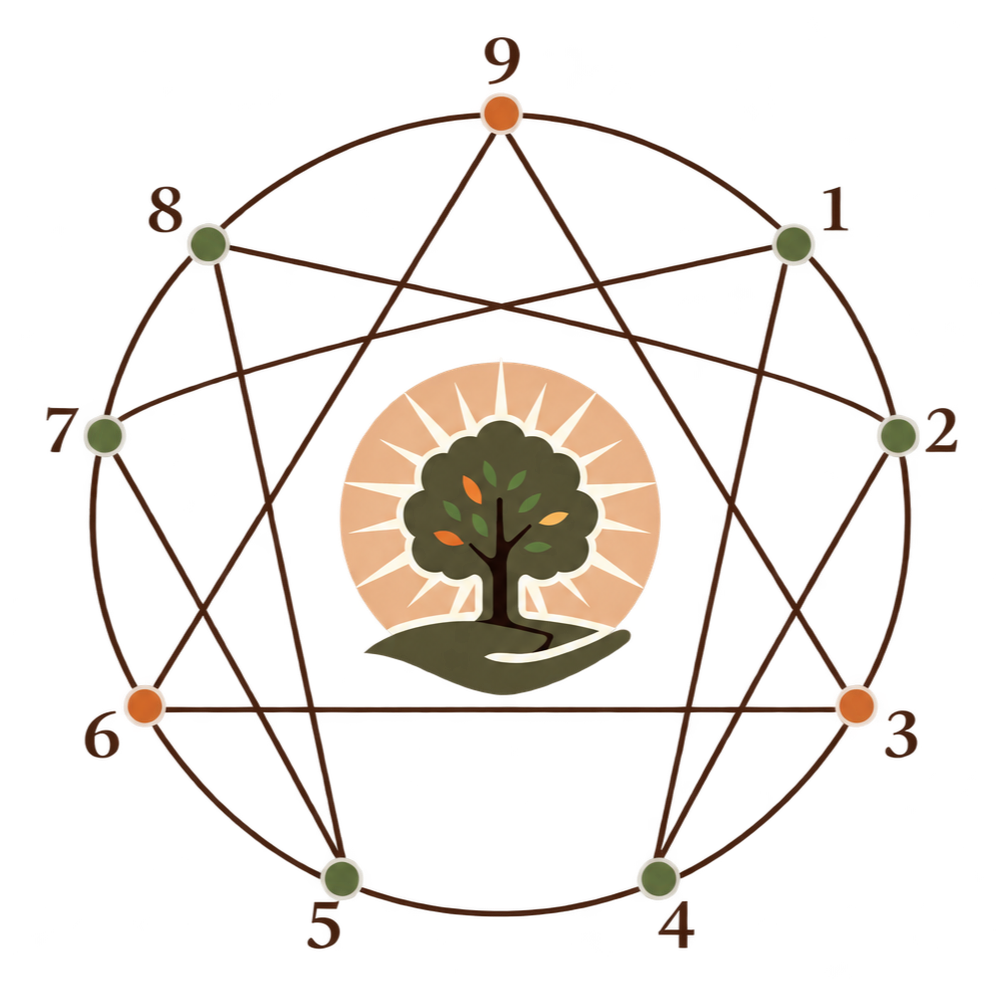
The Enneagram is a map of nine ways of being human.
Each of the nine types describes a distinct way of seeing the world: what we pay attention to, what we long for, what we fear, and the strategy we developed early in life to feel safe and loved. Two people can sit in the same room, in the same conversation, and experience something entirely different depending on which lens they're looking through.
Unlike many personality frameworks, the Enneagram is less interested in your behavior than in your motivation. It asks not what you do, but why. Two people can do the very same thing for completely different reasons, and it's the reason that reveals the type.
Why I love it
The Center for Action and Contemplation describes it as a tool that shows us our wounds, our wisdom, and our work. It is the lens through which our life arc can be viewed. I believe so strongly that the things that are most challenging for us are also our greatest teachers and working through them can reveal what we are at our core.
Our wounds are the strategies we built early on to feel safe, loved, and worthy. They served us then. They often limit us now.
Our wisdom is the gift underneath each strategy. Every type carries something genuinely beautiful: a way of seeing that can guide us and others.
Our work is where the map can lead us. The wisdom we uncover through inner work reveals more clearly what is ours to do in our lives and in the world.
What I love most is that the Enneagram doesn't ask you to become someone else. It helps you loosen your grip on the version of yourself you built to get by, so the person underneath has room to breathe.
A brief history
The story of the Enneagram as we know it today is layered.
The nine-pointed symbol was introduced in the West in the early 1900s by G.I. Gurdjieff, a spiritual teacher who used it to describe processes and transformation, not personality.
The nine personality types came later. In the 1950s and 60s, Oscar Ichazo, a Bolivian teacher, connected the symbol to nine core patterns of ego, drawing on a wide range of philosophical and mystical sources. In the 1970s, the Chilean psychiatrist Claudio Naranjo brought that teaching to the United States and developed it further with insights from modern psychology.
From there it spread in two directions: into contemporary psychology and coaching, and into contemplative Christian circles through teachers like Richard Rohr, whose work continues to shape how many people encounter it today. Though its modern form emerged in the last hundred years, while it draws on very old wisdom about human nature.
What the Enneagram is not
It's not a box. Your type describes a pattern, not a limit. Knowing it gives you more freedom, not less.
It's not a test result. No questionnaire can tell you who you are. In our work together, you explore and discover your own type. I'll never assign you one.
It's not a way to label your children. I don't type kids. Children are still forming, and a label placed too early can become something they live up to. With young people, the Enneagram stays quietly in the background, informing how I understand and support them.
It's not a religion or a belief system. It's a tool. My work is welcoming to people from religious, spiritual, and secular backgrounds alike.
Where to start
If you're curious, an Enneagram Type Exploration is a spacious first conversation about what drives you, what you bring, and where your growth is calling.